
DigiNav’s Ultimate 5G Router Showdown
The 5G-PI Reveals a Clear Winner for Performance and Value!
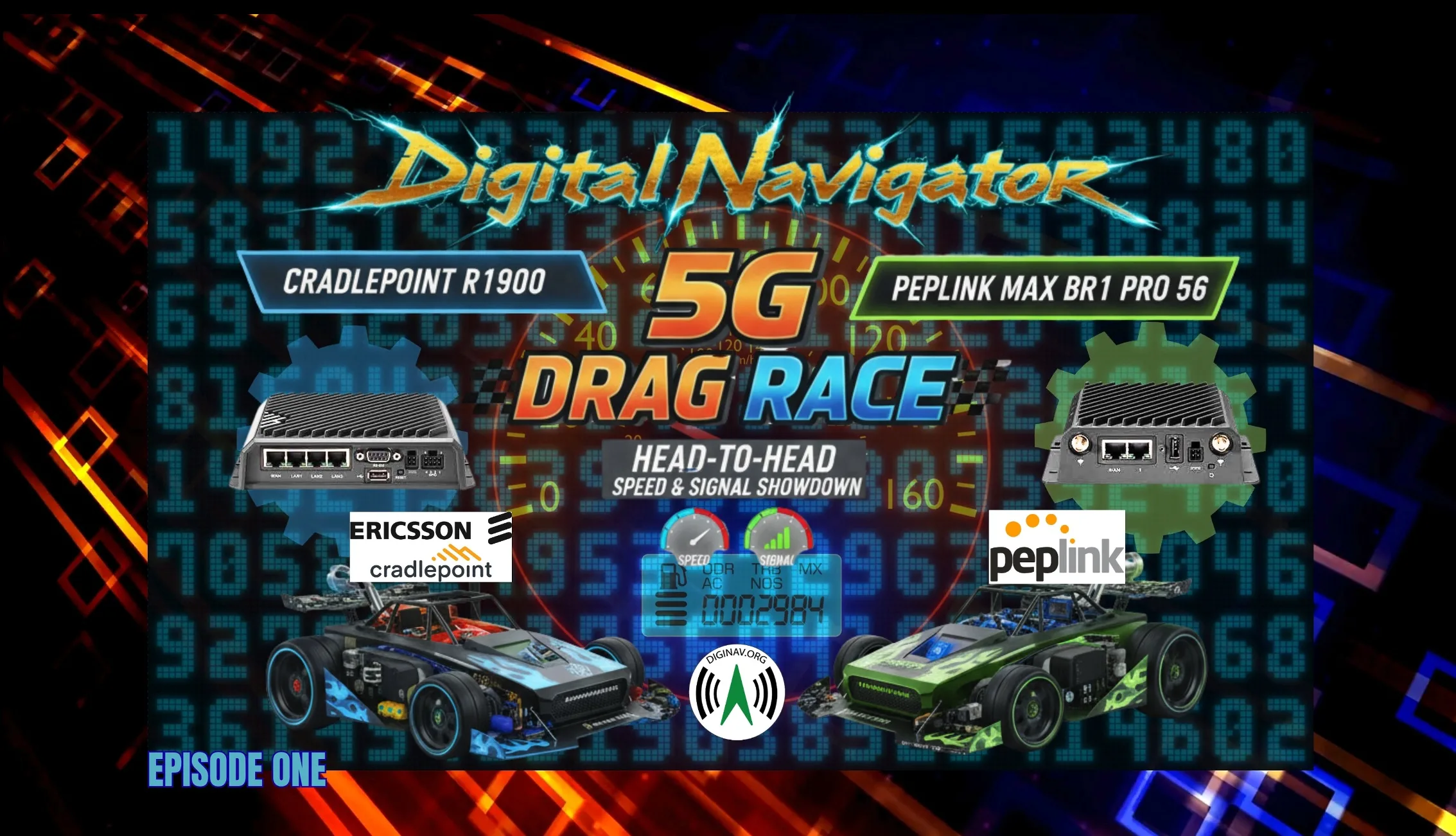
The 5G Drag Race is a structured, comparative performance test between two leading 5G cellular routers, designed to measure not just raw speed, but overall value. The evaluation goes beyond traditional benchmarks by focusing on the 5G Performance Index (5G-PI), which is a strategic metric that weighs technical performance against the financial investment.The purpose of the 5G Drag Race is to provide a clear, value-based analysis to help organizations select the mobile 5G solution that provides the optimal return on investment.
I originally got the idea to start 5G Drag Race when studying the real world use of cellular routers by my customers. I observed that frequently customers were either buying too much power for their needs, or too little despite the price of the radio. With dozens of cellular routers in our inventory of a variety of manufacturers, I decided to create a methodology that would represent the router’s Total Cost of Ownership for 1 year’s use as the basic standard for evaluation. Proverbial “Bang for Buck” comparisons. This opens the door for other similar comparisons that may be based on other metrics or use cases but focused on technical evaluation in detail. Additionally, “5G Drag Race Tuning” will address performance modifications, tips and tricks, and other knowledge based information to bring some clarity in discerning the true value of various pieces of equipment in similarly varying deployments and scenarios. Let the best radios win!
🏁 5G Drag Race: Official Rules & Methodology
We believe in full transparency and dislike “cherry-picked” data. Our 5G Drag Race results are based on real-world, non-curated conditions to give you the most accurate comparison possible.
📍 No Cherry-Picking Locations: Real-World Testing
Tests are done in a variety of common, everyday locations—**rest stops, campgrounds, parking lots**—anywhere a typical user might need a powerful network solution. We are not showcasing best-case scenarios, but *real-world* ones.
Our default “home base” for tests is our office on the edge of Lake Lewisville in Dallas. This is an **intentionally poor cellular location** (towers point away from the lake), and speeds rarely exceed 100 Mbps down / 4 Mbps up on any device. When field tests aren’t possible, the drag race will be run here to establish a consistent, low-bar baseline.
📐 Position & Orientation Rules
The performance of any cellular device is extremely sensitive to its placement. To eliminate environmental bias:
- **Identical Setup:** Position and orientation are always duplicated across all routers for a given test.
- **One At a Time:** Tests are run one at a time. This prevents positional advantages, channel selection conflicts, or Quality of Service (QoS) interactions between the competing routers.
📡 Carrier & Configuration
- **SIM Cards:** All tests are performed on **Verizon Unlimited ($55/month, 100GB data cap)** cards. Whatever the network can offer, it gets. (Note: Other carriers may outperform Verizon in some areas, but Verizon offers the best combination of pricing and North Texas network strength for our baseline.)
- **Accessories:** Radios are tested with **identical antennas** in identical positions and orientations. Custom configurations that may offer an advantage (like Constant Bit Rate or Software Defined Networks) are reserved for “HOT RODDING” head-to-head episodes in the future.
📶 Connection & The 5G-PI
- **Connection Type:** All connections for speed tests are **Wi-Fi** unless otherwise stated, run on the 5GHz band. If a router supports **Wi-Fi bonding** (2.4GHz/5GHz) as a default, easy-to-use option, we use it and give a slight scoring edge for that functionality.
- **5G-PI Definition:** The **5G Performance Index** is ultimately the **Total Cost of Ownership (TCO) per unit of aggregated performance**. Radios sold with everything needed out of the box (like power supplies and antennas) get points. Expensive or proprietary licenses (which most users don’t need) are heavily factored into the TCO.
Understanding the 5G Performance Index (5G-PI)
The **5G-PI** is a weighted metric that combines crucial operational data—Wi-Fi capacity, upload speeds, and critical application latency—and evaluates it against the Total Cost of Ownership. A higher 5G-PI indicates better overall value and operational readiness for your investment.
For our comparison today, we’re using a simplified 5G-PI formula:
5G-PI = (Upload Speed + (1 / Ping) * 1000 + Device Capacity) / Cost
This formula allows us to directly compare different routers by normalizing their key performance indicators against their price.
Why Upload Speed is the Core Quality Indicator for 5G-PI
In the context of the “5G Drag Race,” the Performance Score prioritizes Upload Speed over Download Speed because Download Speed is mainly used to calculate the annual Cost per Mbps. Upload Speed, conversely, is a stronger measure of the router’s ability to handle demanding, symmetrical workloads.
Here is a comparison of why high, stable upload speed signifies better overall network quality:
|
Aspect |
Download Speed (The “Race” Metric) |
Upload Speed (The “Quality” Metric) |
|
Primary Limitation |
Often limited by carrier cell tower capacity and backhaul infrastructure. |
Primarily limited by signal quality (RSRP/RSRQ) and the router/modem’s ability to transmit data back to the tower. |
|
TCP/IP Role |
Handles the receiving of data for activities like streaming and browsing. |
Handles Acknowledgments (ACKs) for all download traffic; stable upload is essential for download stability. |
|
Critical Use Case |
Handles consumption (e.g., streaming Netflix). |
Handles Production/Real-Time Communication: Live video feeds, file synchronization, Zoom/VoIP stability, and large data uploads (e.g., raw video footage). |
|
Indicator of Quality |
Headline speed. Reflects available carrier bandwidth in good conditions. |
Link Resilience. Reflects the quality of the wireless link path, signal cleanliness, and overall symmetrical link health. |
|
SD-WAN Dependence |
SD-WAN primarily uses this speed to determine the maximum achievable throughput and calculate cost efficiency. |
SD-WAN bonding and remediation tools (like SpeedFusion) rely on stable upload links to maintain session persistence and actively correct jitter/loss for real-time services. |
A high upload speed is difficult to maintain and is a truer indicator of the quality of the physical wireless connection established by the cellular router. For business applications that involve sending data or real-time communication, upload is paramount.